Color season
Soft Summerin color analysis: the palette, and how to know if it's you
Soft Summer color analysis: soft neutrality where everything blends.
Soft Summer is the low-chroma, slightly cool season: dusty colors that blend into each other at low contrast. Mauve, foggy blue, sage and antique rose harmonize; pure color, neon and stark black-and-white cut across the face. Taupe grey is the right neutral.
The four dimensions
Every season is defined by four objective axes. They are what TOP measures — never a guess.
Your palette
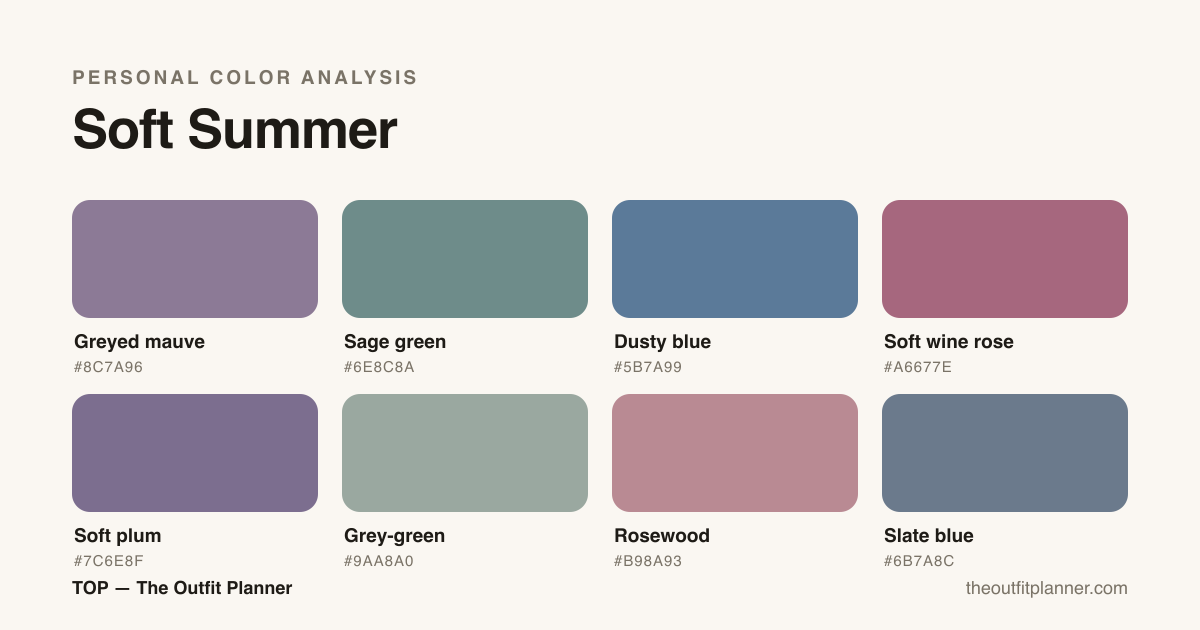
The season's character
Soft Summer lives on the cool-neutral border: low chroma, everything muted and elegant. Low contrast. Very pure colors look harsh on the face — the charm is the dusty tone. It bridges to the Soft Neutral.
How to recognize
Soft Summer lives on the cool-neutral seam: skin with a neutral to slightly cool base, hair and eyes in a muted mid tone, without strong contrast between them. Low chroma is the hallmark — very pure colors seem to shout on your face, and the charm is in the dustiness. If you've ever felt 'no strong color suits me,' this may be it.
How to combine
Work dusty tones close to each other — mauve with sage, slate blue with wine rose — keeping everything at a low volume. Avoid pairing a pure color with a very light neutral: high contrast washes you out. Matte silver beats shiny metals.
The palette in real life
At work
For the office, Soft Summer reads as effortless authority when you stay within the palette. Three combinations that work every time: grey-green trousers with a rosewood blouse and a dusty blue blazer — the trio layers without competing. Second option: a slate blue midi skirt with a sage green silk shirt and nude-rose pointed-toe flats. Third: a two-piece set in greyed mauve with a soft plum belt or scarf as the only accent. What to avoid? Pure black near the face, bright white, orange, and anything with high chroma — these colors create contrast the Soft Summer complexion is not built to absorb, and they make the skin read as dull or reddened. Color analysis for this season is about quiet confidence: the palette does the work so you do not have to. In practical terms, avoid pairing a very dark base with a very light top in the same outfit — the gradient between Soft Summer tones should always feel gradual. Keep transitions smooth, and the overall impression will be polished and cohesive without looking like you tried too hard.
At parties and events
Events are where Soft Summer gets to be deliberately beautiful without abandoning its signature restraint. The one rule: choose your metal first, because it sets the tone for everything else. Matte silver and rose gold are the palette metals — pure yellow gold pulls warm and clashes with the cool-neutral undertone. For formal dresses, soft plum, soft wine rose, or greyed mauve in fabrics like silk crepe, brushed satin, or lightweight velvet give the palette the dimension it needs under indoor lighting. Separates: a rosewood satin top with slate blue wide-leg trousers and a silver clutch. Accessories: long drop earrings in matte silver or pale rose gold, a fine chain necklace. One rule to engrave: never mix two metals in the same evening look. If the earrings are silver, every other metal detail follows. Soft Summer color analysis thrives under diffused interior light — when the venue is warm and dim, lean toward the lighter end of the palette (sage green, rosewood, dusty blue) to preserve the natural luminosity of the complexion.
Day to day
Day to day, Soft Summer is the easiest palette to live in because every color in it already speaks to the others. Combinations that come together in seconds: mid-wash grey-toned jeans with a sage green tee and greyed-white canvas sneakers. An oversized dusty blue coat over greyed mauve leggings and flat rose leather boots. A soft plum linen dress with rattan sandals and a natural-weave tote. The pocket rule: when you cannot decide between two shades in the palette, pick the lighter one. Soft Summer gains through softness, not saturation. Avoid very dark indigo denim (too high in contrast) and any piece with a bold graphic or high-contrast print. Small florals in palette tones, plaid in dusty blue and rosewood combinations, and delicate stripes in sage and greyed mauve are the patterns that support this color analysis season best. The whole wardrobe philosophy is simplicity through coherence — nothing needs to shout.
The season's capsule wardrobe
The Soft Summer capsule is built on one principle: every piece earns its place by combining with at least four others in the group. Ten items chosen from the core palette — greyed mauve, sage green, dusty blue, soft wine rose, soft plum, grey-green, rosewood, and slate blue — cover work, casual, and events without a single purchase outside the season. The selection filter is not trend, it is chromatic coherence. Capsule dressing for this color analysis season is not about minimalism as an aesthetic; it is about removing the morning friction that comes from owning colors that fight each other. Every item listed below was chosen because it fills a specific role in the rotation and because it keeps the palette cohesive across all contexts. Ten pieces, every combination flattering, no decision fatigue.
- Dusty blue blazer — the professional anchor, pairs with every neutral and mid-tone in the capsule.
- Grey-green tailored trousers — versatile base that moves from office to dinner without needing a change.
- Rosewood fine-knit tee — the inner layer that elevates any combination and reads as a warm neutral.
- Greyed mauve midi skirt — the length that balances proportions and carries the season's signature color.
- Soft plum wrap dress — the event wildcard, dressed up with heels or down with flat boots.
- Sage green silk shirt — worn open over the rosewood tee or alone as a full look.
- Slate blue longline coat — the outer layer that grounds any lighter combination in the capsule.
- Mid-wash grey-toned jeans — the only denim in the capsule, washed to stay within the palette's softness.
- Soft wine rose structured top — elevates the evening look paired with tailored trousers or the midi skirt.
- Floral scarf in palette tones — multiplies combinations, adds texture without breaking chromatic harmony.
Makeup, hair and accessories
Soft Summer makeup follows one directive: amplify, do not replace. Lip color: muted mauve-rose, cool berry, or desaturated wine — a single product transforms the look. Avoid pure red, orange-red, and yellow-nude, all of which make the skin read as sallow or flushed. Blush: cool raspberry, muted rose, or dusty mauve applied to the apple of the cheek and blended softly toward the temple. Eye shadow: greyed lilac, dusty blue, or antique rose in satin or soft matte finishes — gold glitter and warm bronze pull orange and clash with the cool undertone of this color analysis season. Eyeliner: graphite or ash brown instead of black; the contrast stays present without becoming harsh. Hair: ashified brunette, cool beige blonde, milk blonde, or any mushroom-tone variation. Platinum blonde can pull yellow on the skin; warm hazelnut brown conflicts with the season's cool-neutral undertone. Red hair works only in deeply desaturated, almost ashy copper — the kind that reads closer to muted rose than to classic auburn. Metal: silver, rose gold, platinum. Classic yellow gold disrupts the palette. Frames: greyed acetate, pale rose, or transparent. One rule: if a product makes the skin look yellowed or ashened within seconds of application, it does not belong to Soft Summer.
Living on the border?
Those who live on the seam between two seasons get the border neutral — TOP doesn't force the choice.
Soft Neutral →Neighboring seasons on the wheel
Still torn between seasons?
Soft Summer vs. Cool Summer — how to tell them apart
Both seasons share the cool undertone, but they diverge in chroma and contrast. Cool Summer accepts more saturated colors and supports greater contrast between skin, eyes, and hair — think royal blue, vivid raspberry, blue-black. Soft Summer needs everything muted: the same hue family, but with grey stirred in. The practical test: hold a pure cobalt blue against your face in natural light. If the color looks harmonious and your face gains luminosity, you may be Cool Summer. If the color feels harsh and the skin looks washed out or reddened, Soft Summer is the better fit. Repeat with dusty blue: if that tone restores warmth and dimension to the face, the identification is confirmed. The Outfit Planner can measure the saturation of your wardrobe pieces from photos and flag when a color falls outside your color analysis range — a useful tool when you are deciding between these two neighboring seasons.
Soft Summer vs. Soft Autumn — the neutral boundary
The overlap is real because both seasons share low chroma and low contrast. The difference is undertone: Soft Summer is cool-neutral, Soft Autumn is warm-neutral. The clearest test: hold an olive green (warm) and a sage green (cool-neutral) side by side against your face. If the olive green makes the skin look alive and the sage green reads flat, you lean Soft Autumn. If the sage green returns luminosity and the olive creates a yellowish shadow on the skin, Soft Summer is the answer. Burnt earth, mustard, and caramel belong to Soft Autumn — on a Soft Summer complexion, those shades make the face recede. People at the true border between the two seasons — sometimes called Soft Neutral — can draw carefully from both palettes, prioritizing the most temperature-neutral shades from each side to build a wardrobe that works in both directions.
Torn between this one and a neighbour?
The two comparisons between this season and the ones it borders: the measurement that splits them, the home tests and what the wrong choice costs.
Frequently asked questions
How do I know if I'm a Soft Summer?
If pure, vivid colors look harsh on you and dusty tones make you elegant, with low natural contrast and a cool-neutral temperature, it's a strong sign. TOP measures chroma and temperature from a photo.
Can a Soft Summer wear black?
Pure black creates too much contrast and hardens. Swap it for taupe-grey, slate blue or soft brown as darks — they respect your softness.
What's the difference between Soft Summer and Soft Neutral?
Soft Summer still leans slightly cool; Soft Neutral is the verdict for those who sit exactly on the seam between Soft Summer and Soft Autumn, with no defined side.
What hair color works best for Soft Summer?
The tones that work best are ashy brunette, cool beige blonde, milk blonde, and any mushroom-blonde variation. These shades mirror the medium value and cool-neutral undertone of Soft Summer color analysis, creating natural harmony across skin, eyes, and hair. Avoid golden blonde, warm hazelnut brown, orange-based red, and pure black. If you are coloring your hair, ask the colorist for 'cool and ashy' as the direction — a blonde with a violet or grey toner works far better than any golden or honey blonde for this season.
Can a Soft Summer wear black?
Pure black is the highest-contrast color possible, and Soft Summer is a low-contrast season. Wearing black close to the face — at a collar, as a necklace, in eyeglass frames — creates a harsh cut that stiffens the features and drains the natural luminosity of the skin. The alternative: slate blue, soft plum, or charcoal grey serve the role of 'darkest shade' in the palette with far better results. If black is unavoidable for a formal context, soften the contrast by placing a greyed mauve scarf or rosewood earrings near the face to bridge the gap.
Hair × season
Hair color for this season
Which natural tone fits, which dyes flatter and what to avoid — in season-specific detail.
Hair color — Soft Summer →Eyewear × season
Eyewear and frames for this season
Which shape, material, frame colour and lens suit you — and what to avoid — in season-specific detail.
Eyewear and frames — Soft Summer →Denim × season
Jeans and denim for this season
Which wash, cut, hardware and topstitch suit you — and what to avoid — in season-specific detail.
Jeans and denim — Soft Summer →Nail polish × season
Nail polish for this season
Which shade, finish, nail shape and effect suit you — and what to avoid — in season-specific detail.
Nail polish — Soft Summer →Jewelry × season
Jewelry and metals for this season
Which metal, stone, pearl and finish suit you — and what to avoid — in season-specific detail.
Jewelry and metals — Soft Summer →Lipstick × season
Lipstick and makeup for this season
Which red, which nude, which blush and which finish suit you — and what washes the face out — in season-specific detail.
Lipstick and makeup — Soft Summer →By weather
Your season in every weather
The coat, the white and the third piece change with the thermometer — here is how this palette handles each one.
Find your season in the app
TOP measures your color from a photo and scores every piece in your closet by your palette. Free to start.
Download on the App Store Get it on Google Play