Color season
Warm Springin color analysis: the palette, and how to know if it's you
Warm Spring color analysis: sunlit gold with a touch of earth.
Warm Spring is the golden, medium-chroma season: sunlit color with a touch of earth, at medium contrast. Coral, apricot, avocado green, warm turquoise and camel work; cool pink, blue-grey and heavy black fight the skin. Gold is the natural metal.
The four dimensions
Every season is defined by four objective axes. They are what TOP measures — never a guess.
Your palette
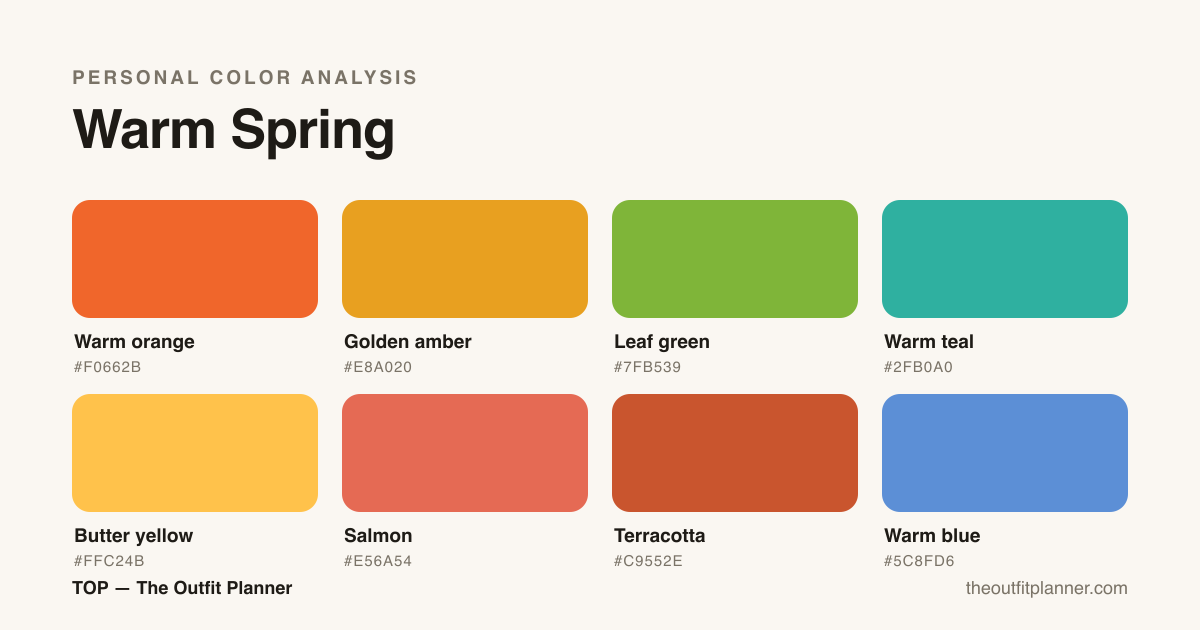
The season's character
Warm Spring is the most golden of the springs: temperature speaks louder than contrast. Skin with a peach/golden undertone and hair that leans honey or copper. It pairs warmth with light — without going too dark.
How to recognize
Warm Spring shows up when gold rules everything: skin with a peach or warm-ivory base, hair leaning honey, copper or golden-brown, and amber, warm-green or light-brown eyes. Golden colors light you up; anything blue or greyed leaves the skin flat and tired. Contrast is medium — not as crisp as the bright, not as soft as the light.
How to combine
Layer warm tones within the same family — amber with leaf green, terracotta with cream — and the palette harmonizes on its own. A warm neutral (camel, cream) anchors the look without competing. Skip cool silver near your face; gold is your best friend.
The palette in real life
At work
Warm Spring in the workplace thrives on golden structure. The most versatile combination: terracotta trousers paired with a salmon blouse and a golden amber blazer. The trio reads polished in a boardroom or a client meeting without veering informal. For more conservative dress codes, try a leaf green midi skirt with a butter yellow shirt tucked in — warm, sophisticated, and readable on screen calls. Third option for hybrid days that turn into in-person commitments: a warm orange wrap dress belted in terracotta leather. What to avoid: cool blue-greys, charcoal, and pure white, which strip away the golden undertone that defines Warm Spring color analysis and make the complexion look flat. Black on its own compresses the medium contrast of this season — if you must include it, confine it to shoes or a bag, never close to the face. The palette of Warm Spring allows more saturated color at work than most people expect: the trick is anchoring with a warm neutral like amber or terracotta and letting one vivid tone carry the look from there.
At parties and events
For evening events, Warm Spring has inherent luminosity — and the mistake is trading it away for safe, cool choices. At a social occasion, lean into a warm teal or warm orange midi dress: both tones hold artificial light without turning neon or washing out. For separates, a salmon flowing skirt with a butter yellow top and gold-heeled sandals delivers elegance that stays fully within the palette. The right metal for this season is yellow gold and copper, not silver or rhodium — long gold or copper earrings amplify the medium-high chroma of Warm Spring without competing with the skin. One non-negotiable rule: resist the all-black evening look — it cancels the luminosity that is Warm Spring's strongest asset. To deepen an outfit for night, reach for deep terracotta or dark leaf green instead. Gold or copper shimmer in eye shadow and lip gloss can be a finishing-touch differentiator on a warm complexion, adding dimension without crossing into costume.
Day to day
Day to day, Warm Spring shines through simplicity: a butter yellow tee, medium-wash jeans, and caramel sneakers covers eight out of ten casual situations without deliberating. For a more intentional outing, swap jeans for leaf green straight-leg trousers and add a leather bag in warm tan. When layering is needed, the most functional combination is a salmon ribbed tank under a medium denim jacket with terracotta ankle boots — warm and cohesive with no effort. The season's pocket rule: when in doubt between two tones, choose the warmer one. Warm Spring color analysis consistently loses energy in cool greys, icy beiges, and desaturated blues, but gains life in any tone carrying gold or orange at its base. Terracotta or golden amber shorts and skirts are summer staples. In cooler months, a chunky knit in warm teal or camel becomes the cozy anchor of every outfit. Two tones from the palette are always enough — Warm Spring does not need complexity to look complete.
The season's capsule wardrobe
A Warm Spring capsule does not need volume — it needs precision. Ten well-chosen pieces in a warm, medium-value, medium-high chroma palette cover work, weekends, and events without conflict. The logic: warm neutrals like terracotta and amber form the base; vivid tones like warm orange and leaf green step in as protagonists; bridge tones like salmon and butter yellow play both roles. With this structure, any two or three pieces from the capsule produce a harmonious outfit because every item shares the golden undertone at the heart of Warm Spring color analysis. Less decision fatigue, more confident dressing.
- Structured blazer in golden amber — anchors any look and transitions from the office to dinner without effort.
- Tailored trousers in terracotta — the season's most versatile warm neutral, replacing cool beige with real personality.
- Midi dress in warm orange — works for parties and urban daywear; the accessories change the register, not the dress.
- Silk blouse in salmon — brings lightness to any outfit and harmonizes with every other piece in the Warm Spring capsule.
- Button-down shirt in butter yellow — the capsule's natural light source, works under the amber blazer or untucked with wide-leg trousers.
- Medium-wash denim jacket — the one permitted cool-leaning neutral: a golden or amber-tinted wash keeps it on-season.
- Midi skirt in leaf green — high-impact vivid tone that channels the medium-high chroma of Warm Spring with easy elegance.
- Cropped top in warm teal — versatile in warm weather and a color layer under the amber blazer when it gets cool.
- Wide-leg trousers in camel — performs the warm neutral trouser role without the cool undertone that beige often carries.
- Leather mule or sandal in caramel — the versatile footwear that ties any capsule combination together without competing.
Makeup, hair and accessories
For makeup, Warm Spring calls for tones that mirror the palette's energy. Coral or warm peach lipstick are the everyday staples — they illuminate the complexion without conflicting with the golden undertone. For evening or events, a terracotta or burnt orange lip intensifies the season's medium-high chroma in a sophisticated way. Avoid raspberry or cool pink lipstick: they subtract warmth from the face instantly. The ideal blush is peach or warm bronze — never cool pink or magenta. For eye shadow, gold, champagne, and copper metallics are the right choices; grey-based or purple tones dull the Warm Spring eye. For hair, the most flattering tones are golden brown, honey, sandy blonde, and warm auburn — any shade with a golden or orange-base reflection activates this color analysis season. Ashy tints, platinum blonde, and blue-based toning work against the undertone. The right accessory metal is yellow gold or copper — avoid silver and rhodium. Frame glasses in warm tortoiseshell, caramel, or gold complement the face without neutralizing the palette. The universal beauty rule for Warm Spring: if the tone has a cool or neutral base, it belongs to another season.
Neighboring seasons on the wheel
Still torn between seasons?
Warm Spring vs Bright Spring: the saturation test
Both seasons are warm and belong to the Spring family, but they differ in contrast level and chroma intensity. The most direct test: hold a saturated warm orange close to your face in natural light. On Warm Spring, the tone looks harmonious — the skin absorbs the colour effortlessly. On Bright Spring, warm orange works but an even more vivid, high-contrast coral looks better because that season needs maximum intensity to avoid looking flat. Second test: hold leaf green to your face. Warm Spring looks balanced; Bright Spring may need a more saturated, electric green to feel right. In short, Warm Spring prefers tones that are warm and golden but slightly softened, while Bright Spring demands the highest chroma available. The TOP app can measure the colour temperature of each garment from a photo, which helps clarify which end of the Spring family fits when the doubt persists between these two neighbours.
Warm Spring vs Light Spring: the depth test
Light Spring is the most delicate of the family: lighter value, lower chroma, and low contrast. Warm Spring sits at medium value with medium-high chroma — it handles denser colours without losing harmony. Practical test: place a deep terracotta tone close to the face. On Warm Spring, it anchors well and adds richness. On Light Spring, deep terracotta can feel heavy and darken the appearance — that season works better with light salmon or soft peach. Second test: rich golden amber. Warm Spring embraces it fully; Light Spring prefers a pale butter yellow, airy and light. If you can wear warm orange without feeling like your face disappears behind the clothes, Warm Spring is the stronger candidate. If saturated tones feel overwhelming, Light Spring is more likely. Color analysis is not binary, but this two-test exercise narrows the margin of uncertainty in a very practical way.
Torn between this one and a neighbour?
The two comparisons between this season and the ones it borders: the measurement that splits them, the home tests and what the wrong choice costs.
Frequently asked questions
How do I know if I'm a Warm Spring?
If gold lights you up while silver/grey dulls you, and your skin/hair have a honey or copper base, it's a strong hint. TOP confirms by measuring your true color from a photo.
Can a Warm Spring wear black?
Black steals the warmth from your face. Swap it for chocolate brown, dark camel or deep olive as your darks — far more harmonious.
What's the difference between Warm Spring and Warm Autumn?
Both are warm, but Warm Spring is lighter and more luminous, and Warm Autumn is deeper and earthier. Spring glows; autumn warms.
What hair color suits Warm Spring the most?
Warm Spring looks best with golden undertones in the hair — honey brown, sandy blonde, warm auburn, and any shade with orange or gold at its base enhance this color analysis season. Avoid platinum blonde, ashy tones, and any colour with a blue or silver base: they create an artificial contrast that works against the warm skin undertone. If your natural hair is dark, fine honey highlights make a noticeable difference without changing the base colour. Warm silver or golden-grey hair is also a harmonious option as the hair naturally lightens, since it keeps the golden warmth that defines Warm Spring.
Can Warm Spring wear black clothing?
Technically yes, but with conditions. Pure black is a cool, high-contrast tone that clashes with the medium contrast and golden undertone of Warm Spring color analysis. The result is usually a look that cancels the skin's natural luminosity instead of enhancing it. If black is unavoidable — a formal event or a strict dress code — keep it as a minimal detail away from the face and compensate with a warm orange or terracotta lip or accessory. The smarter alternative for deepening a Warm Spring outfit is dark terracotta or deep leaf green — both are harmonious without requiring correction.
Hair × season
Hair color for this season
Which natural tone fits, which dyes flatter and what to avoid — in season-specific detail.
Hair color — Warm Spring →Eyewear × season
Eyewear and frames for this season
Which shape, material, frame colour and lens suit you — and what to avoid — in season-specific detail.
Eyewear and frames — Warm Spring →Denim × season
Jeans and denim for this season
Which wash, cut, hardware and topstitch suit you — and what to avoid — in season-specific detail.
Jeans and denim — Warm Spring →Nail polish × season
Nail polish for this season
Which shade, finish, nail shape and effect suit you — and what to avoid — in season-specific detail.
Nail polish — Warm Spring →Jewelry × season
Jewelry and metals for this season
Which metal, stone, pearl and finish suit you — and what to avoid — in season-specific detail.
Jewelry and metals — Warm Spring →Lipstick × season
Lipstick and makeup for this season
Which red, which nude, which blush and which finish suit you — and what washes the face out — in season-specific detail.
Lipstick and makeup — Warm Spring →By weather
Your season in every weather
The coat, the white and the third piece change with the thermometer — here is how this palette handles each one.
Find your season in the app
TOP measures your color from a photo and scores every piece in your closet by your palette. Free to start.
Download on the App Store Get it on Google Play