Color season
Light Springin color analysis: the palette, and how to know if it's you
Light Spring color analysis: warm pastels, light and luminous.
Light Spring is the light, gently warm season: luminous pastels, low contrast and nothing heavy. Peach, aqua, butter yellow, light blue and soft coral keep the face fresh; black, deep wine and dark neutrals weigh it down. Warm beige and off-white are the neutrals.
The four dimensions
Every season is defined by four objective axes. They are what TOP measures — never a guess.
Your palette
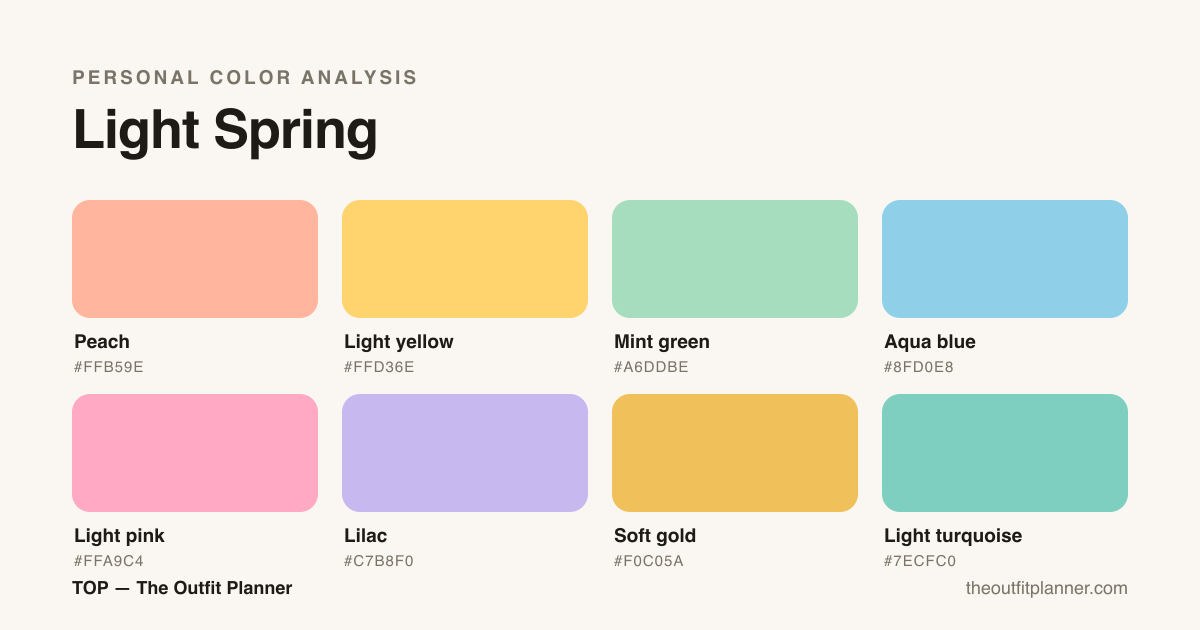
The season's character
Light Spring is delicate and sunlit: high value (everything lighter) with a warm base. Low contrast — the face wants light colors that don't weigh it down. It's the bridge to the Light Neutral.
How to recognize
Light Spring is light and sunlit: fair skin with a slightly warm base, blond to light golden-brown hair and light eyes. The strongest trait is high value — everything about you is light, and the contrast between hair, skin and eyes is low. Dark or very saturated colors overwhelm you; warm pastels give back your freshness.
How to combine
Stay in light tones and keep contrast low — peach with ivory, mint with cream. A light monochrome look flatters more than black-and-white. If you need a dark accent, use a soft brown or mid denim instead of black.
The palette in real life
At work
Light Spring works best in professional settings when you keep contrast low and stay within your warm, clear palette. Three combinations that work: first, tailored trousers in warm beige with a crepe blouse in mint green and nude-rose flat — polished without relying on black. Second, a sheath dress in light pink with a structured blazer in the palest butter yellow and soft gold heels — the metal ties the look together without adding weight. Third, a pencil skirt in light turquoise with a warm off-white button-down and a thin gold belt — classic with color. What to avoid: monochromatic outfits in cool tones like charcoal or pure optical white, which drain the natural luminosity that Light Spring color analysis is built around. Black as a base at work is risky — if unavoidable, pull it away from your face with a scarf in peach or lilac. The rule of thumb: if a color makes you look more tired or washed out under office lighting, it does not belong in your palette.
At parties and events
At parties and events, Light Spring really comes into its own. An aqua blue evening dress is an excellent choice — the tone has enough presence for a bright venue without feeling flat or heavy. For separates, wide-leg trousers in lilac with a light pink lace body and gold sandals create a sophisticated look that stays fully within the palette. The metals for this season are soft gold and warm gilt — avoid cool silver and oxidized gold, both of which create too much contrast against warm skin. Subtle shine in fabrics like chiffon, gold lurex, or peach satin works well because it amplifies light without adding visual weight. For an intimate dinner, a mint green co-ord set with a light turquoise stone necklace is effortless and on-palette. The party rule for Light Spring: do not push the contrast. A dark dress with a bright accessory — or vice versa — works against the season's natural harmony. Let the tones blend softly into each other.
Day to day
For everyday wear, Light Spring calls for lightness and ease. Light-wash jeans with a light pink T-shirt and an off-white sneaker is the perfect starting point — tones within the palette, zero effort. A second option: linen trousers in light yellow with a warm beige tank top and a flat sandal in nude caramel — great for warm weather, breathable, and effortlessly put together. In cooler months, layering a peach cardigan over a warm white tee (not optical white — use off-white or cream) and light mint trousers works beautifully. Bags in caramel leather or natural straw complement any casual Light Spring look without pulling outside the palette. The casual rule of thumb for Light Spring: if a piece reads as cool-toned — dark purple, mid-grey, forest green — it will work against you. Always choose the lighter, warmer version. Light Spring color analysis is built on the principle that your best colors look like natural daylight.
The season's capsule wardrobe
The Light Spring capsule exists to prove that ten well-chosen pieces produce more outfits than a wardrobe full of wrong colors. The logic of the season is medium chroma at high value — colors that are present and clear, never heavy or muted, with a lot of luminosity. When every piece shares that DNA, any combination works. You do not need a black basic if you have mint green that functions as a visual neutral within the palette. The ten pieces below are designed to cover work, casual, and party without stepping outside the harmony of Light Spring color analysis.
- Butter-yellow blazer — anchors work looks with warmth and polish, keeping the season's luminosity front and center.
- Warm beige tailored trousers — the season's warm neutral, replacing black with far better harmony for Light Spring.
- Aqua blue midi dress — versatile enough for events and meetings, the tone has depth without pushing contrast too high.
- Warm off-white button-down shirt — the layering base; sits better against warm skin than pure optical white.
- Light pink T-shirt — the palette basic, works under a blazer, under a cardigan, or alone with light-wash jeans.
- Mint green A-line skirt — brings freshness to casual and workwear, pairs with off-white, peach, and warm beige.
- Light-wash jeans — the only neutral blue in the capsule, balances color without breaking the palette's warm temperature.
- Peach cardigan — the season's transition layer, softens any look and creates a luminous effect when placed near the face.
- Soft gold sandal or heel — the single metal in the capsule, unifies party, work, and casual looks in one shoe.
- Structured caramel leather bag — the warm anchor of the capsule, grounding Light Spring outfits without pulling off-palette.
Makeup, hair and accessories
In makeup, Light Spring color analysis calls for warm-temperature, high-value pigments — clear and warm, never muddy or dark. Lip color: peach nude, light coral pink, or a soft warm raspberry. Deep wine or burgundy lipstick flattens the face and creates a contrast the palette cannot support. Blush: always peach or salmon-rose with a subtle luminous finish — Light Spring skin responds well to a healthy glow. Eyeshadow: champagne gold, warm beige, and soft mint green for daytime. For evening, light turquoise on the lid with a gold inner corner highlight is a precise and flattering combination. Heavy contour or cool bronzer throws off the balance — instead, reach for a warm rose-gold highlighter applied with a light hand. For hair, Light Spring finds its best expression in golden tones: butter blonde, light golden brown with honey highlights, and warm auburn or strawberry blonde. Going dark or adding cool ash or platinum will drain the vibrancy the season is built around. If your natural hair is dark, keep it and use your clothing palette (peach, light pink, mint) near your face to create the luminous effect. Accessories: soft gold and warm gilt are the season's metals — cool silver competes with the warmth of the palette. For glasses, choose frames in gold, caramel, warm peach, or translucent rose. The general rule for Light Spring beauty: any element that cools down or darkens goes against the palette.
Living on the border?
Those who live on the seam between two seasons get the border neutral — TOP doesn't force the choice.
Light Neutral →Neighboring seasons on the wheel
Still torn between seasons?
Light Spring vs Warm Spring: how to tell
The main difference between Light Spring and Warm Spring in color analysis comes down to chroma and value: Warm Spring can carry higher saturation and deeper, richer tones — think pure canary yellow and burnt orange. Light Spring needs everything softer and lighter. The practical test: hold a saturated pure yellow close to your face. If it illuminates your skin without casting a yellow tint, you likely have Warm Spring characteristics. If it feels overwhelming and pulls attention away from your face, the soft butter yellow of Light Spring will serve you far better. A second test: try a deep coral versus a peach. Warm Spring handles the deeper shade comfortably; Light Spring looks best in the paler, softer version. The Outfit Planner (TOP) can help identify this by reading the saturation and temperature of the colors in your wardrobe photos — if your most flattering pieces consistently land on the lighter, softer side of the warm spectrum, Light Spring is your season.
Light Spring vs Light Summer: the neutral bridge
Light Spring and Light Summer share the same high value — both seasons live in clear, light tones. The key difference is temperature: Light Spring is warm, while Light Summer is neutral-cool, leaning toward cooler pinks and dusty lavenders. The practical test: hold a pure baby pink — cool-toned, no yellow — close to your face. If it illuminates your skin, you may have Light Summer characteristics. If it makes your skin look slightly grey or flat, the warm temperature of Light Spring is what flatters you. The colors that overlap between the two seasons are light pink and soft lilac — but Light Spring uses the warmer, slightly golden versions, while Light Summer prefers the cooler, more muted analogues. If you find yourself equally comfortable in both, you are likely in the Light Neutral zone, which bridges the two seasons and accepts colors from both at slightly lower saturation.
Torn between this one and a neighbour?
The two comparisons between this season and the ones it borders: the measurement that splits them, the home tests and what the wrong choice costs.
Frequently asked questions
How do I know if I'm a Light Spring?
If you're light overall (skin, hair and eyes) with a slightly warm base, and dark colors seem to weigh you down, it's a strong sign of Light Spring. TOP measures value and temperature from a photo.
Can a Light Spring wear black?
Black is usually too heavy for your light value. Prefer light neutrals — ivory, light camel, denim — that respect your lightness.
What's the difference between Light Spring and Light Summer?
Both are light and low-contrast, but Light Spring has a warm base and Light Summer a cool one. It's the Light Neutral border — those in the middle get that neutral.
What hair color works best for Light Spring?
Light Spring calls for warm, golden tones in the hair. Butter blonde, light golden brown with honey highlights, warm auburn, and strawberry blonde are the best choices for anyone considering a change. These tones mirror the warm temperature of the palette and add luminosity around the face. Avoid cool platinum, ash grey, and dark brown without warm undertones — all of them suppress the natural brightness that Light Spring color analysis is built around. If your hair is naturally dark and you prefer to keep it that way, use your clothing palette to compensate: pieces in peach and light pink near the face create the luminous effect the season needs.
Can Light Spring wear white?
Pure optical white is not the strongest choice for Light Spring. The season has low contrast and high value, so the sharp brightness of optical white can create an imbalance that works against the natural harmony of the palette. It does not need to be avoided entirely, but it works better away from the face — as a trouser or shoe — paired with a warm piece on top. The white that truly works for Light Spring is warm white: off-white, cream, or ivory with a subtle yellow or peach undertone. These tones respect the temperature of the season without the jarring contrast that optical white introduces. Warm white near the face is one of the most flattering neutrals a Light Spring can own.
Hair × season
Hair color for this season
Which natural tone fits, which dyes flatter and what to avoid — in season-specific detail.
Hair color — Light Spring →Eyewear × season
Eyewear and frames for this season
Which shape, material, frame colour and lens suit you — and what to avoid — in season-specific detail.
Eyewear and frames — Light Spring →Denim × season
Jeans and denim for this season
Which wash, cut, hardware and topstitch suit you — and what to avoid — in season-specific detail.
Jeans and denim — Light Spring →Nail polish × season
Nail polish for this season
Which shade, finish, nail shape and effect suit you — and what to avoid — in season-specific detail.
Nail polish — Light Spring →Jewelry × season
Jewelry and metals for this season
Which metal, stone, pearl and finish suit you — and what to avoid — in season-specific detail.
Jewelry and metals — Light Spring →Lipstick × season
Lipstick and makeup for this season
Which red, which nude, which blush and which finish suit you — and what washes the face out — in season-specific detail.
Lipstick and makeup — Light Spring →By weather
Your season in every weather
The coat, the white and the third piece change with the thermometer — here is how this palette handles each one.
Find your season in the app
TOP measures your color from a photo and scores every piece in your closet by your palette. Free to start.
Download on the App Store Get it on Google Play