Color season
Light Summerin color analysis: the palette, and how to know if it's you
Light Summer color analysis: cool, light freshness like watercolor.
Light Summer is the light, cool-based season: watercolor tones, low contrast and freshness without weight. Dusty pink, sky blue, lavender, mint and light grey suit it; orange, mustard and solid black harden the face. Silver and pearl grey beat antique gold.
The four dimensions
Every season is defined by four objective axes. They are what TOP measures — never a guess.
Your palette
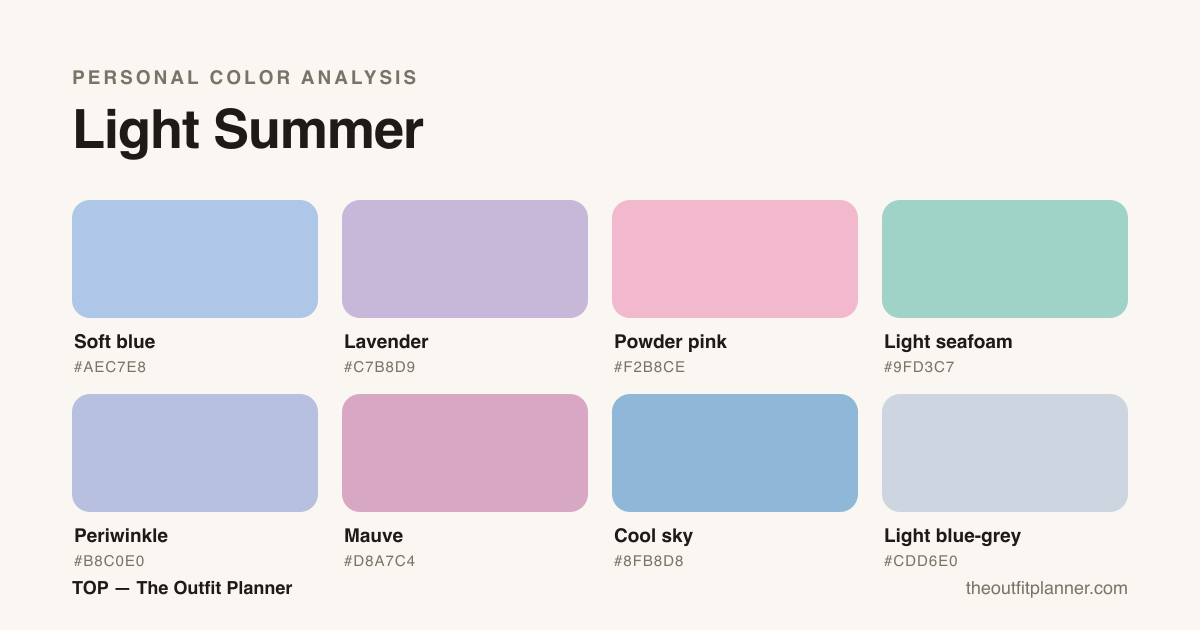
The season's character
Light Summer is fresh and soft: high value on the cool side. Low contrast, washed, delicate colors. It bridges to the Light Neutral from the cool side.
How to recognize
Light Summer is fresh and delicate: fair skin with a rosy or cool-neutral base, ash-blond to cool light-brown hair and soft light eyes (blue, grey-green). High value and low contrast, but cool in temperature. Warm colors turn you sallow; washed blues and pinks light you up softly.
How to combine
Prefer cool, light tones, all with a veil of grey — soft blue with cool off-white, lavender with pearl grey. Tone-on-tone combinations flatter more than strong contrasts. Silver beats gold near your face.
The palette in real life
At work
The Light Summer palette in a professional setting communicates polish without relying on strong contrast. Three concrete combinations work consistently well. First: tailored trousers in light blue-grey with a blazer in soft blue and a powder pink shell — the harmony of close values reads as intentional and put-together without effort. Second: a pencil skirt in mauve paired with a periwinkle blouse and a cool-toned nude pump, which keeps skin tone at the center of the look. Third: a full suit in soft blue with a lavender shirt underneath — monochromatic within the palette, refined, and quietly confident. What to avoid: warm beige, camel, and any golden neutral that pushes the complexion toward yellow. Chocolate brown and pure black break the characteristic lightness of the Light Summer palette, pulling luminosity away from the face. Lean on the season's cool neutrals — light blue-grey and muted lavender — as your base for any professional outfit. Color analysis for Light Summer shows that the complexion is read as elegant and credible in corporate environments precisely because it operates on precision, not volume of color.
At parties and events
For parties and formal events, Light Summer has room to shine within its own logic of soft sophistication. A dress in cool sky paired with a silver accessory is the strongest combination for formal occasions: the cool temperature of the blue and the cool temperature of silver reinforce each other and lift the skin. For more relaxed gatherings, try two separates — a fluid lavender skirt with a powder pink top — and a silver sandal or cool nude flat. Those who want a more dramatic look within the palette can explore mauve in a midi dress, paired with a periwinkle clutch and long silver earrings. The one rule for Light Summer at parties: choose one main color point and let the rest of the look fall into the season's cool neutrals. Gold, bronze, and copper compete with the skin rather than elevating it. Silver sequin or soft blue beading, on the other hand, produce exactly the luminous effect that suits this color analysis season.
Day to day
In everyday life, the Light Summer palette translates into combinations that look intentional without visible effort. Light cold-wash denim — blue-toned, never warm indigo — with a light seafoam t-shirt and white sneakers with a cool undertone is the easiest starting point. For a slightly more defined casual look, pair linen trousers in light blue-grey with a periwinkle blouse and a mauve flat. Another everyday favorite: a casual powder pink midi dress with a flat silver sandal. On cooler days, a soft blue trench coat or a light blue-grey blazer completes any combination without disrupting the palette's harmony. The Light Summer rule of thumb for casual dressing: if the piece has a warm undertone, it will draw more attention than you want. When choosing between two shades, go with the cooler and lighter one. Light Summer color analysis rewards delicacy over contrast every time.
The season's capsule wardrobe
The Light Summer capsule is built around one principle: high value, cool temperature, moderate saturation. You do not need many colors because the entire palette already operates in natural harmony — each piece speaks to the others without effort. Ten items cover work, parties, and daily life with enough combinations for months of wear. The key is making sure the neutrals are the right neutrals: light blue-grey and muted lavender instead of warm beige or cream. With that base in place, any accent in soft blue, mauve, or light seafoam enters as an intentional color point. This capsule was built for anyone who wants versatility without sacrificing coherence with their own color analysis season.
- Soft blue blazer — anchors work looks and elevates casual outfits with immediate credibility.
- Light blue-grey tailored trousers — the cool neutral that replaces black without losing the palette's lightness.
- Lavender midi dress — the most versatile piece, moves from casual to formal with just a shoe change.
- Powder pink silk blouse — adds soft femininity, pairs with every cool neutral in the capsule.
- Mauve pencil skirt — the boldest color point for formal settings, brings sophistication within the palette.
- Light cold-wash jeans — the casual foundation, must have a blue-cool undertone, never warm indigo.
- Periwinkle shirt — versatile between work and weekend, functions as a main piece or open layer.
- Light seafoam basic t-shirt — a light color accent for daily wear, pairs with jeans and cool neutrals.
- Light blue-grey overcoat — the capsule coat, a cool neutral that competes with nothing worn underneath.
- Silver mid-heel sandal — the right metal for this season, transitions from work to party without effort.
Makeup, hair and accessories
Light Summer makeup follows the same logic as the palette: cool, light, and moderately saturated. For lip color, the most flattering shades are powder pink, soft mauve, and sheer cool rose — avoid orange-red, coral, and warm beige, which conflict with the cool undertone of the skin. For blush, cool pink and mauve applied lightly produce the most natural healthy look; peach or terracotta blush adds an unwanted yellow cast. For eyeshadow, lavender, cool grey, and smoky pink enhance the eye without demanding dramatic contrast. A grey-brown liner works better than pure black for everyday wear. For hair, the most flattering tones are ash blonde, cool platinum, light brown with ash or cool beige highlights, and natural silver. Warm tones — copper, auburn, golden blonde — dull the natural luminosity of a Light Summer complexion. If grey hair is present, growing it out often flatters more than dyeing with a warm color. For metals, silver, white gold, and cool rose gold are the allies. Yellow gold and bronze pull too warm. For eyewear, silver frames, translucent lavender, or cool grey-blue complement the face with harmony. The general rule: keep the cool undertone consistent across every layer of your look and the result will always feel deliberate.
Living on the border?
Those who live on the seam between two seasons get the border neutral — TOP doesn't force the choice.
Light Neutral →Neighboring seasons on the wheel
Still torn between seasons?
Light Summer versus Light Spring
Both seasons share high value — both are light and luminous — but they differ in temperature, and that difference is what color analysis hinges on when distinguishing the two. To identify which one you are, do a concrete test: hold a warm golden yellow next to a cool sky blue and observe which one brings a healthy glow to your skin. Light Spring will respond well to the warm yellow and peach; Light Summer will appear washed out in those shades and come alive in the blue and lavender. A second test: compare a pure white top with an off-white that has a slightly cool rosy cast. Light Spring handles pure white easily; for Light Summer, pure white tends to create shadow under the eyes. Skin undertone also differs: Light Spring carries a golden warm undertone, while Light Summer leans pink or slightly grey-cool. The Outfit Planner measures color temperature by photo and can help identify which direction your skin pulls when placed next to calibrated reference colors.
Light Summer versus Cool Summer
Within the Summer family, the distinction between Light Summer and Cool Summer sits in value and saturation. Cool Summer tolerates deeper, more intense shades within the cool palette — navy, cool burgundy, more saturated raspberry. Light Summer needs to stay in the higher value range; when the value drops significantly, the face loses light. To test, hold an intense navy next to a cool sky blue. If the navy sits well — without creating excessive contrast — you are likely closer to Cool Summer. If the sky blue makes your face glow and the navy feels too heavy, you are Light Summer. Another concrete reference: compare a medium lavender with a very pale lavender. Cool Summer handles the more saturated version comfortably; Light Summer prefers the near-white version of the color. Light Summer is the bridge to Light Neutral precisely because it can absorb a minimal touch of warmth without washing out — something Cool Summer cannot do. The Outfit Planner logs the value of each wardrobe item and flags when a combination drops too far in contrast for the season's profile.
Torn between this one and a neighbour?
The two comparisons between this season and the ones it borders: the measurement that splits them, the home tests and what the wrong choice costs.
Frequently asked questions
How do I know if I'm a Light Summer?
If you're light with a cool (rosy) base and low contrast, and washed cool colors flatter you while warm ones dull you, it's a strong sign. TOP measures the cool temperature and high value from a photo.
Can a Light Summer wear black?
Black is too intense for your light, soft value. Soft navy, blue-grey and cool off-white work far better as dark anchors.
What's the difference between Light Summer and Cool Summer?
Both are cool, but Light Summer is lighter and softer, and Cool Summer has more depth and saturation. Light whispers; cool speaks at a mid volume.
What hair color suits a Light Summer complexion?
The most flattering hair colors for Light Summer are those that stay in the cool family at medium to light value. Ash blonde, cool platinum, light brown with ash or cool beige highlights, and well-maintained natural silver are the top choices. Warm tones — copper, auburn, golden blonde, chocolate brown — create a clash with the pink or slightly grey-cool undertone of the skin, making the face appear less luminous. If your natural hair is dark brown, cool face-framing highlights will frame the face with more harmony than an all-over warm color. Natural grey, when healthy and styled, is often one of the most flattering options for anyone with a Light Summer color analysis.
Can a Light Summer wear black?
Pure black is a challenge for Light Summer because it demands a contrast level that the palette does not naturally carry. It can work away from the face — in trousers or shoes — but close to the face it tends to cast shadow and reduce the natural luminosity of the skin. The most effective substitute is deep cool grey: it keeps the cool temperature of black without demanding the same contrast load. In situations where black feels unavoidable, balance it with a makeup or accessory choice in the palette — soft mauve blush or a cool rose lip — to bring warmth back to the face. With practice and deeper knowledge of your own color analysis, most Light Summer people find they are glad to let black go.
Hair × season
Hair color for this season
Which natural tone fits, which dyes flatter and what to avoid — in season-specific detail.
Hair color — Light Summer →Eyewear × season
Eyewear and frames for this season
Which shape, material, frame colour and lens suit you — and what to avoid — in season-specific detail.
Eyewear and frames — Light Summer →Denim × season
Jeans and denim for this season
Which wash, cut, hardware and topstitch suit you — and what to avoid — in season-specific detail.
Jeans and denim — Light Summer →Nail polish × season
Nail polish for this season
Which shade, finish, nail shape and effect suit you — and what to avoid — in season-specific detail.
Nail polish — Light Summer →Jewelry × season
Jewelry and metals for this season
Which metal, stone, pearl and finish suit you — and what to avoid — in season-specific detail.
Jewelry and metals — Light Summer →Lipstick × season
Lipstick and makeup for this season
Which red, which nude, which blush and which finish suit you — and what washes the face out — in season-specific detail.
Lipstick and makeup — Light Summer →By weather
Your season in every weather
The coat, the white and the third piece change with the thermometer — here is how this palette handles each one.
Find your season in the app
TOP measures your color from a photo and scores every piece in your closet by your palette. Free to start.
Download on the App Store Get it on Google Play